Civil War Officer's Cavalry Sword
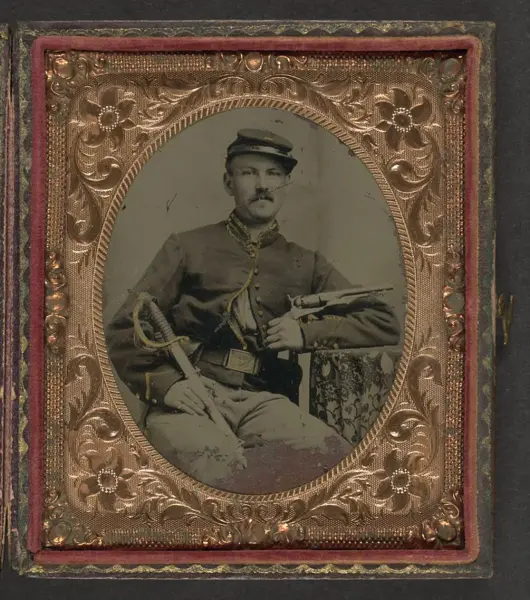
Wikimedia Commons, Public Domain
- Model 1860 pattern — the most widely used cavalry sword of the Civil War
- Curved blade designed for mounted slashing attacks
- Brass three-branch guard with "US" marking
- Complete with original steel scabbard
Blade shows areas of mild pitting but no active rust. Brass guard retains good detail. Leather grip wrap has wear but is intact. Scabbard has dents consistent with field use.
- Scattered pitting on blade from age and storage conditions
- Scabbard has field-use dents
- Leather grip wrap shows wear and minor losses
Overall length approximately 41 inches (104 cm); blade length approximately 34 inches (86 cm).
The American Civil War (1861-1865) was the last major conflict where cavalry sabers saw widespread combat use. These swords were carried in some of the war's most famous engagements and represent an important category of Civil War military collecting.
Named Officer's Presentation Sword
$12,000circa 1863
Engraved presentation sword identified to a specific officer with battle history
Same period; provenance to a named individual dramatically increases value
Model 1860 Staff & Field Officer's Sword
$3,500circa 1862
More ornate officer's sword with etched blade and gilt guard
Higher-grade version of the same era military sword
Confederate Cavalry Saber
$8,000circa 1862
Confederate-manufactured saber, much rarer than Union equivalents
Same use but far lower production numbers command significant premium
A Civil War-era Model 1860 Light Cavalry Saber in good condition with its original scabbard. This was the workhorse sidearm of the Union cavalry, and surviving examples are popular with both Civil War collectors and arms enthusiasts. The presence of the original scabbard adds value. Identification of the specific manufacturer and any inspector markings could refine the valuation. The Civil War collecting market remains robust with strong institutional and private demand.
Check for inspector stamps on the blade ricasso and guard. "US" should be stamped on the guard. Blade should show appropriate pattern-welded or crucible steel structure. Original blades are heavier than modern reproductions. Examine scabbard mounting hardware for period-correct construction. Ames Manufacturing Co. and other contracted makers often marked their products.
- Apply a light coat of Renaissance wax to blade to prevent further oxidation
- Store in a stable, low-humidity environment
- Handle with cotton gloves to prevent fingerprint corrosion
- Never attempt to sharpen or heavily clean — patina is desirable